

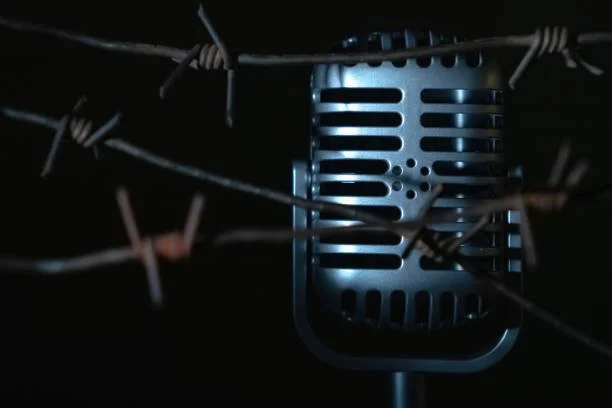
Behind Bars: Music May Offer Healing Few Prisoners Can Otherwise Access
Michelle Mikhels
March 2026
6 minute read
“You can cage the singer but not the song.” —Harry Belafonte
Music is deeply embedded in the daily lives of most Americans. According to a July 2022 report, 52 percent of U.S. adults reported personally creating or performing art in the previous 12 months.[1] Engagement is even higher on the listening side: more than 69 percent of adults reported listening to or viewing music through media such as television, radio, streaming services, or recordings during the same period.
Research suggests that this engagement is not merely recreational. A 2023 study found that music listening “may be a means to modulate stress and mood during psychologically demanding periods.”[2] One group living through psychologically demanding conditions is people who are incarcerated, often facing unique psychological and emotional strains. Largely isolated from their families and placed in a stressful environment that severely restricts their personal freedoms, many prisoners experience declines in their psychological and emotional well-being.
According to a May 13, 2021, article by the Prison Policy Initiative, “Incarceration itself is inherently harmful to human health.[3]” Professor Craig Haney explains, “At the very least, prison is painful, and incarcerated persons often suffer long-term consequences from having been subjected to pain, deprivation, and extremely atypical patterns and norms of living and interacting with others.”[4]
Can music help? Evidence indicates the answer is yes. However, documentation of the efficacy of music therapy in U.S. correctional institutions is minimal. For example, a March 2022 study published in Voices: A World Forum for Music Therapy surveyed 542 board-certified music therapists in the U.S. and found that only 52 reported working in correctional settings.[5] Lorna Segall and Olivia Yinger, the authors of the study, summarize their findings as follows: “Although the United States has the highest incarceration rate in the world and music therapy has existed in U.S. correctional facilities for almost a century, little is known about music therapists who provide services to people who are incarcerated.”
The authors trace the history of music therapy in the U.S. back to 1923, when Willem van de Wall’s Music in Correctional Institutions suggested that music was a worthwhile method of rehabilitation “because of its capacity to create an environment of expressive and thoughtful development and to provide opportunities for group work, self-expression, and self-discipline.”[6]
Yet another study published in the International Journal of Offender Therapy and Comparative Criminology in January 2024, found that “there is difficulty in conducting research in prisons due to limitations imposed on researchers, a paucity of randomized-control trials, and limited generalizability of results due to the heterogeneity of methodological approaches.”[7] The study included literature spanning from 1987 to 2022 that explored the role and influence of musical practices on well-being “in carceral settings such as jails, prisons, and immigration detention centers.”[8] Although the study pointed out weaknesses in existing research, it found that music has an overall positive effect on the well-being of incarcerated individuals.
Just what is music therapy? A June 29, 2022, article published by the National Alliance on Mental Illness titled Music Therapy: More Than Just Entertainment,written by Melinda Murray, defined music therapy as “an established health profession in which music is used within a therapeutic relationship to address physical, emotional, cognitive and social needs of individuals.”[9] Murray attributed this definition to the American Music Therapy Association. According to Murray, music therapy can help to lower blood pressure, improve memory, enhance communication and social skills, encourage self-reflection, reduce muscle tension, teach self-regulation, and manage pain.[10] Relatedly, a 2023 study that examined the effects of listening to music on a daily basis during the COVID-19 lockdown found that it was significantly associated with lower stress levels and improved mood, particularly among those experiencing elevated, chronic stress.[11]
While rare, some music therapy and music-based rehabilitation programs do exist in select correctional facilities across the country. In 2024, Eagle Point Complex at Lewis Prison in Arizona, a prison that houses male inmates with trauma histories and serious mental illness, launched the state’s first art and music therapy program.[12] In New Jersey, the Edna Mahan Correctional Facility for Women offers a music therapy program directed by Rutgers University focused on stress management.[13] At the federal level, the Federal Medical Center (FMC) Butner provides structured group and individual music therapy for 250 inmates, focusing on emotional and social needs through “Strummin & Hummin” showcases.[14] Similar programs exist in South Carolina[15] and Nevada.[16] These programs, however, remain the exception rather than the norm.
If music therapy programs are helpful to the prison population, why are they so rare? The primary answer appears to be funding. California, for example, offers a strong music therapy program at all of its 35 state adult correctional facilities. According to a September 25, 2024, press release issued by California Arts in Corrections, the program is funded by “an $8 million annual commitment.” Scalability may also be an issue, given that this work presents unique challenges.[17]
Elisha Ellis Madsen, a music therapist who worked at the California Medical Facility in Vacaville from 2013 to 2017, documents her experience:
The prison was dark, musty, and mostly concrete with a side of asbestos. There was little temperature control, so on hot days (which were many) it easily reached 85 degrees inside my office, a converted prison cell with two tiny desks, my prison-issued guitar, and a barred window that looked out onto our unit’s recreation yard. On cold days, it typically averaged around 50 degrees in my office. My “cellie” (the name we used for our office partners) and I wore heavy coats, scarves, and gloves just to sit and type our treatment documentation notes. It was hard to complain about these conditions, because just on the other side of my office’s wall were the inmates’ prison cells, so they were subjected to the same temperature extremes as me. The only difference is that I got to go home at the end of each day.[18]
Music therapy in American prisons isn’t rare or poorly documented because it is unproven or impractical. It is rare because it exposes a contradiction at the heart of our prison system: We claim to prioritize rehabilitation while resisting practices that actually provide it.
[1] Snyder, Thomas, et al. Report | September 2024 50 States of Arts Participation: 2022, National Arts Statistics and Evidence-based Reporting Center, National Endowment for the Arts , Sept. 2024, www.arts.gov/sites/default/files/topical-rpt-state-sppa_202409.pdf.
[2] Feneberg, Anja C, et al. “Perceptions of Stress and Mood Associated with Listening to Music in Daily Life during the COVID-19 Lockdown.” JAMA Network, 10 Jan. 2023, jamanetwork.com/journals/jamanetworkopen/fullarticle/2800161.
[3] Quandt, Katie Rose, and Alexi Jones. “Research Roundup: Incarceration Can Cause Lasting Damage to Mental Health.” Prison Policy Initiative, 13 May 2021, www.prisonpolicy.org/blog/2021/05/13/mentalhealthimpacts/.
[4] Ibid.
[5] Segall, Lorna E, and Olivia S Yinger. “Music Therapy in US Corrections: Philosophy, Practice, and Protocols of Music Therapists Working with Incarcerated People in the US.” Voices, 1 Mar. 2022, voices.no/index.php/voices/article/view/2872.
[6] Ibid.
[7] Im, V., & Pinto, R. M. Expanding Knowledge About Music and Well-Being in Carceral Settings: A Methodological Review. International Journal of Offender Therapy and Comparative Criminology, 69(12), 1627-1644. https://journals.sagepub.com/doi/10.1177/0306624X231219210.
[8] Ibid.
[9] Murray, Melinda. “Music Therapy: More Than Just Entertainment.” National Alliance on Mental Illness, 29 June 2022, www.nami.org/blog/music-therapy-more-than-just-entertainment/.
[10] Ibid.
[11] Feneberg AC, Stijovic A, Forbes PAG, et al. Perceptions of Stress and Mood Associated With Listening to Music in Daily Life During the COVID-19 Lockdown. JAMA Netw Open. 2023;6(1):e2250382. doi:10.1001/jamanetworkopen.2022.50382. https://jamanetwork.com/journals/jamanetworkopen/fullarticle/2800161#248777410
[12] O’Kelley, Kaley. “First-of-Its-Kind Therapeutic Art and Music Therapy Program Launches inside Arizona Prison.” ABC15 Arizona in Phoenix (KNXV), ABC15 Arizona in Phoenix (KNXV), 18 Oct. 2024, www.abc15.com/news/local-news/first-of-its-kind-therapeutic-art-and-music-therapy-program-launches-inside-arizona-prison.
[13] Verbanas, Patti. “Prisoners Find Hope through Music.” Rutgers University, 22 Feb. 2016, www.rutgers.edu/news/prisoners-find-hope-through-music#:~:text=A%20music%20therapy%20program%20at,%E2%80%93Karen%20Anne%20Melendez.
[14] “Music Therapy Plays to Reentry: FMC Butner Music Therapy Program Helps Inmates Develop Life Skills While Healing.” Federal Bureau of Prisons, www.bop.gov/news/20160909_music_therapy.jsp#:~:text=FMC%20Butner%20Music%20Therapy%20Program,performers%20work%20together%20on%20selections.
[15] “Freedom to Play: Music As Prison Rehabilitation.” YouTube, Great Big Story, www.youtube.com/watch?v=myDWhetc7Xo.
[16] Forrest, Brett. “Music Therapy Program Helps Washoe County Mental Health Inmates.” KRXI2, 18 Nov. 2021, mynews4.com/news/local/music-therapy-program-helps-washoe-county-mental-health-inmates.
[17] “California Arts Council Releases Request for Proposals to Contract with Organizations to Provide Arts Learning Opportunities at State Correctional Institutions.” California Arts Council, 25 Sept. 2024, arts.ca.gov/press-release/california-arts-council-releases-request-for-proposals-to-contract-with-organizations-to-provide-arts-learning-opportunities-at-state-correctional-institutions/.
[18] Madsen, Elisha Ellis. “Music behind Bars: Confessions of a Prison Music Therapist.” Feel Creative Wellness, Feel Creative Wellness, 7 Jan. 2024, www.feelcreativewellness.com/blog/musicbehindbars.